Start
Never flown before
The honest order for someone who has never flown: what to check first, what to buy first, and why a simulator comes before an aircraft.
Checked
Do these in order
- 01
Work out which hobby you actually want first
FPV freestyle, FPV racing and camera-drone flying are three different hobbies that happen to share a word. They do not share much hardware: a freestyle quad is built to survive crashes and fly aggressively close to obstacles, a racing quad is built for straight-line speed around a known track, and a camera drone is built to hold a shot steady and land itself if you let go of the sticks. Buying equipment for one and expecting it to serve another is the single most expensive mistake at this stage, more expensive than any individual component decision that comes later.
If what you actually want is aerial footage without learning to fly manually, the honest answer is to skip the FPV path in this section altogether and go straight to choosing a camera drone. If what you want is the stick skill, the crashes and the community around building your own aircraft, the rest of this page is for you.
- 02
Buy a simulator and a decent radio before you buy an aircraft
A flight simulator that reads input from a real radio transmitter is the one purchase on this page that costs almost nothing next to what it protects. The difference it makes is blunt: crashing in a simulator costs you nothing, crashing a new build in its first minute in the air costs you a rebuild. Every hour spent learning stick coordination, rates and throttle management in a simulator is an hour not spent repairing or replacing hardware.
The radio matters more than the simulator itself, because it is the one piece of equipment that survives every aircraft you build or buy after this one. Buying a capable radio now, even before you own anything for it to control, is a rational sequence: look for enough channels for the switches you will eventually want, a receiver protocol that is not tied to a single manufacturer's aircraft, and USB or dongle support for simulator use. None of that requires an aircraft to exist yet.
- 03
Read the regulation section before you fly, not after
The rules that apply to you can require action before the aircraft leaves the ground, not after a first flight goes well. Operator registration under EU rules can apply independent of what the aircraft weighs or costs, and it is the operator, not a specific aircraft, who registers. What exactly applies to your case, the age at which it starts and the exceptions that exist are covered in the regulation section and specifically under registration, not on this page.
Regulation
Operator registration is a legal obligation where it applies, not a suggestion. Confirm your own situation on the registration page before your first flight, including with a rented or borrowed aircraft.
EASA, Drones (UAS), checked 25 July 2026. easa.europa.eu - 04
Choose between ready-to-fly and building your own
A ready-to-fly aircraft removes one variable: if it flies badly, the problem is your piloting, because the hardware came pre-tuned by someone who builds many of them. That is a genuine advantage for a first aircraft, whatever the internet's enthusiasm for building from parts suggests.
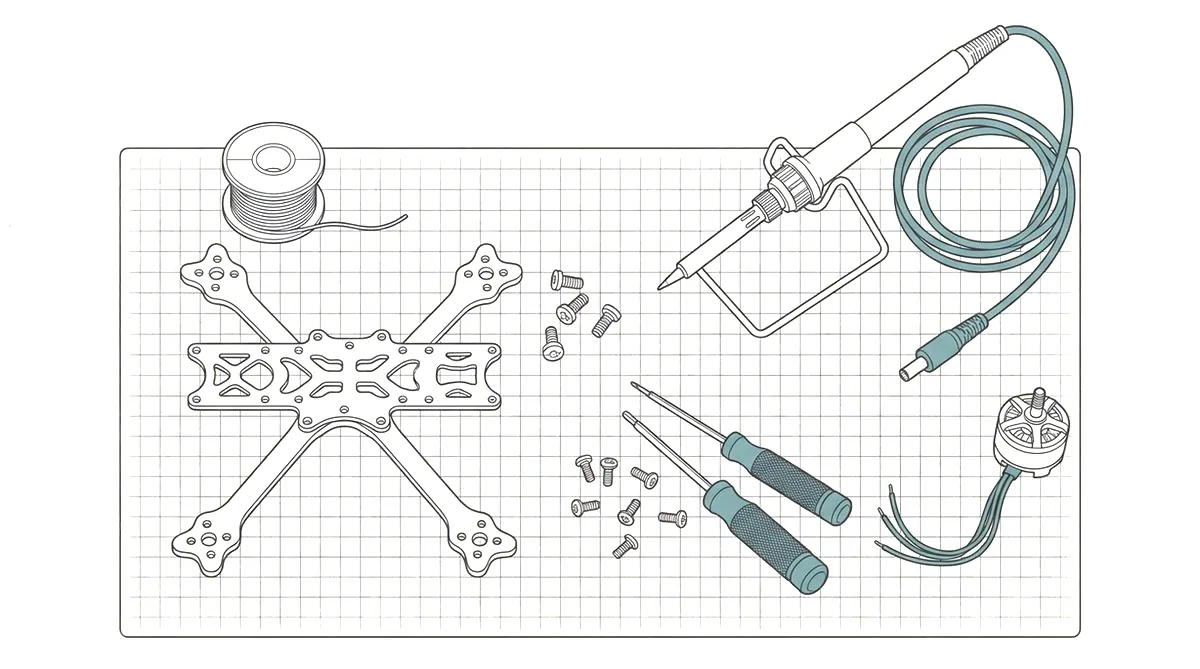
Building is not as simple as a parts list makes it look. A first build carries assembly mistakes you cannot yet recognise: a loose connector, a flight controller mounted a few degrees off level, a motor wired to spin the wrong way before you flash the firmware to correct it. If your first build is also your first flight, you have no way to tell whether a bad flight is a tuning problem or a piloting problem, because you have never flown anything else to compare it against. The first build guide covers this in more depth if building is still what you want to do; a simulator and, ideally, time on someone else's ready-to-fly aircraft first make that first build far easier to debug.
- 05
Find a legal site before you find a convenient one
Where you are allowed to fly is decided nationally underneath a shared EU framework, and it depends on more than distance from your front door: proximity to airports, population density and locally designated no-fly zones all narrow the list. A field that looks empty is not the same as a field that is legal, and the two questions are answered in different places. The regulation section explains the framework; the specific zones for where you live are not something this page can look up for you.
An organised model flying club, where one exists, usually solves this in one step: the site is already cleared, and the community around it is worth more to a beginner than the field itself.
- 06
Fly the first flight line of sight, not through goggles
Your first flight should be flown looking at the aircraft, not through FPV goggles, regardless of how eager you are to see the world through the quad's camera. Keep it low, keep it slow, and expect the first attempts to be about getting the aircraft to hover roughly where you put it, rather than about doing anything with it.
Once you do move to goggles, you lose your own view of the surroundings, which is why a spotter, a second person watching the aircraft and the airspace around it with their own eyes while you fly, is not an optional nicety for FPV flight. It is the difference between someone seeing an obstacle in time to warn you and nobody seeing it at all.
- 07
Expect propellers and arms to break first, and carry spares
The parts that fail first on a new pilot's aircraft are the cheapest and most exposed ones: propellers chip or shatter on contact, and thin frame arms crack on a hard tip-over before anything more expensive is damaged. That is by design as much as by accident. Frame guides describe arm thickness as one of the variables that decides what survives a given impact; thinner, lighter arms fly better and break sooner, and that tradeoff is deliberate on most frames built for this stage of flying.
Keep spare propellers on hand from day one, because you will need them before you need anything else. Spare arms or a spare frame, and a basic understanding of what a printed mount or guard can protect on the next crash, become worth having once you are flying often enough that repairs are routine rather than rare. The full component picture, once you know which of it you need, is at components.